Journal #19

Q: In the 20th century, we see the ascendancy of the style tribes. Please name and describe two of these tribes – what was their ideology and how was it reflected in their clothing? Can you think of an example of a style tribe of today – post a picture!

A: Style tribes were groups who could be recognized by their style, but was almost a uniform. One of the style tribes was Hip-Hop. They were bright colors, baggy clothes, and may have even carried around big boomboxes. The boombox really aligns with their culture since they were together for, dressed for, and cared a lot about the hip-hop music and culture. They dressed like the popular hip-hop artists of the time and played the music on their boombox.

Another easily identifiable style tribe was this fitness and body craze. As you can probably guess, this ‘tribe’ was all about fitness and showing off that very thin, Jane Fonda like bodies. This can be seen in the way they wore clothes all the time that could have been worn to work out. When it was the leggings and leg warmers or the swimsuit like workout suit, they were showing off the body and fitness they were so dedicated to.

Not sure if I can think of a wide spread example, however on this campus… the SNC Football Team is a style tribe. My roommates and I always joke at the beginning of the year about how we know the exact day the football coaches give out apparel because from that day on, they all looked the same. They all have the same jackets, hats, and t-shirts. It is so easy to discern them from other sports teams on campus. (I tried getting pictures but I could not get any good ones without being seen. Imagine SNC football apparel from head to toe).
Journal #20

Q: What was your favorite piece of clothing/fashion style/movement from the past semester? Feel free to post an image.

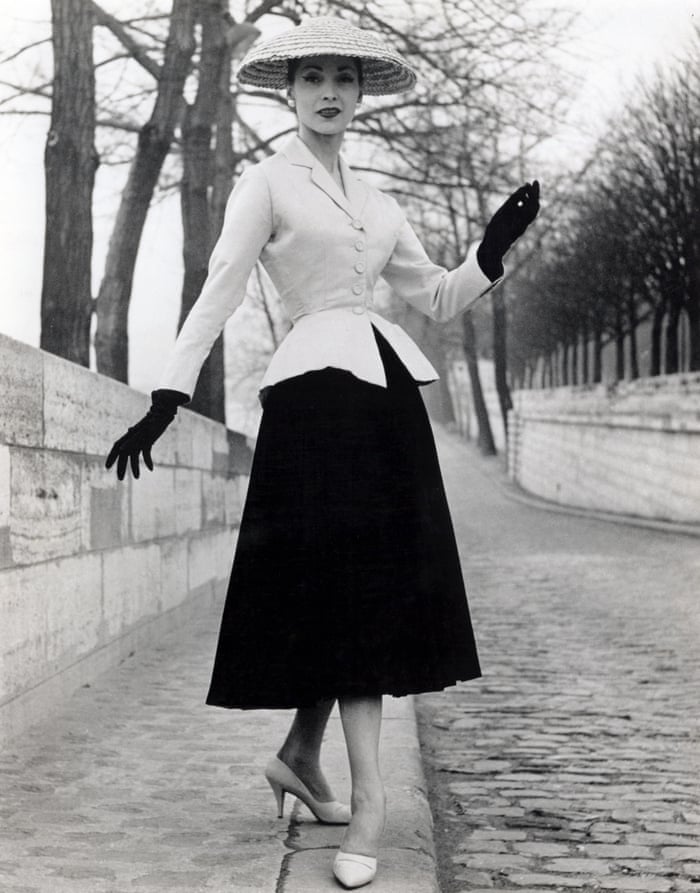
A: My favorite look in this class was the late 1940’s Dior look. I would never be able to pull it off myself, but I think it is so beautiful. Part of it is that it is relatively plain in color, I feel like that relates to my style. The other part is just the flattering shape and classy look. Again, I would never dress like this, however, it is always that one look I wish I could pull off. We can see the midi skirts and dress coming back and I want nothing more to join in but at 4’11 the proprotions do not quite work out.

https://www.theguardian.com/fashion/2017/feb/16/christian-dior-french-fashion-1947

Journal 18 – Late 20th Century Morgue

This is Op Art fashion from the 60’s. This can be identified by the colorful, crazy patterns on the dresses which were not skin tight.
https://www.trendvibes.eu/l/all-you-need-is-love-reliving-the-1960s/
This is a Mod Tent dress, this can be identified by the smaller, very circular neckline with almost no shape after the neckline.
https://startsat60.com/discover/opinion/nostalgia/the-sewing-patterns-we-remember-from-the-60s-and-70s

Journal 17 – Early 20th Century Morgue

Seen here is a woman driving coat, these were needed due to the openness of the cars. they were loose, formless, buttoned-up coat.
https://www.dar.org/museum/fashioning-new-woman-1890-1925-0
One can tell that this dress is of the early 20th century due to the extreme s-curve that is pushing her chest forward and her hips backwards. (This photo is not in color becuase it was actually taken in the early 20th century. I felt it would more accurately show the shape of the time.)
http://www.vam.ac.uk/content/articles/c/corsets-early-20th-century/
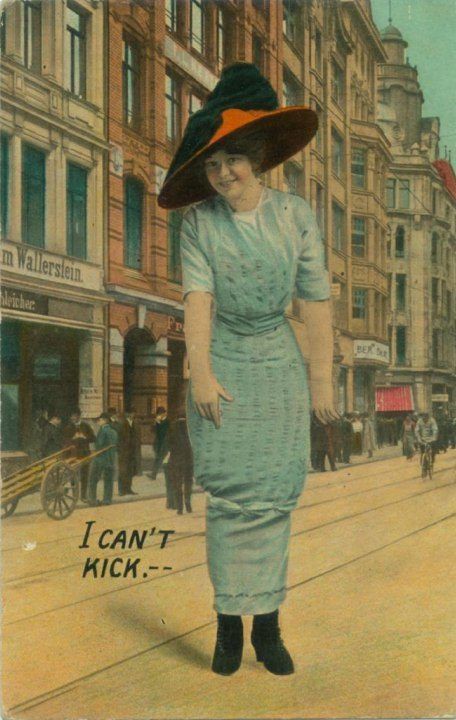
This woman is wearing a Hobble Skirt. This can be identified by the narrowness from the knees down. This seriously hindered a woman’s ability to walk, thus making them hobble.
https://medium.com/@kanupriya.goenka/why-did-the-hobble-skirt-become-popular-e86dbdd06880

Journal #16

Q: What are some of the reasons behind the dress reform movement of the late 19th century? What sort of clothing came out of the movement?

There were several reasons for dress reform. Some of these included First Wave Feminism, this focused on legal inequalities like a woman’s right to vote, temperance, women’s education, the suffrage movement, and moral purity. There was a move away from the impractical clothing and a move towards rational dress and covering the body. Luckily for women, there was a move away from corsets as well; both health and moral implications were cited as reasons against corsets. With the end of corsets came the sporting movement, women could not wear the enormous dresses and get on a bicycle and expect they would bust their stuff.

Thus far, I have talked mostly about women, so I will now discuss the changes of the men’s clothing. Men started to wear ditto suits (matching suits – coat, waitcoat, and trousers), which gave them a very block like shapes. They also started wearing underdraws which acted as sort of an undergarment. During this time, men’s clothing did not change very drastically in comparison to the women’s clothing.

Journal 15 – 19th Century Morgue

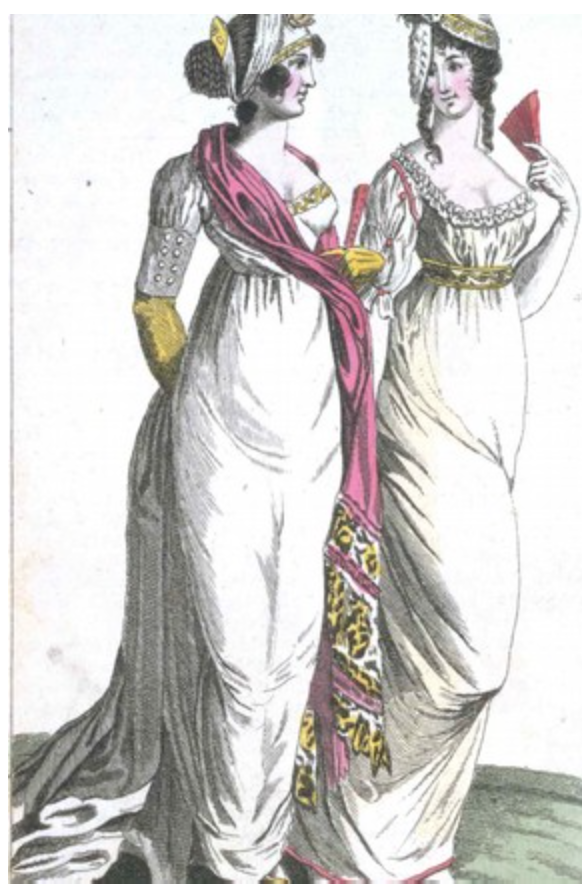
You can tell this is a Neo-Classical style, a revival of ancient Greek or Roman clothing. This is clear in the high waistline right under the breast, and the figure hugging clothing.
http://www.vam.ac.uk/content/articles/i/introduction-to-19th-century-fashion/
You can see that thesis a Garrick. There are multiple collars and it is long in length (it looks just like the coat seen in the Christmas Carol).
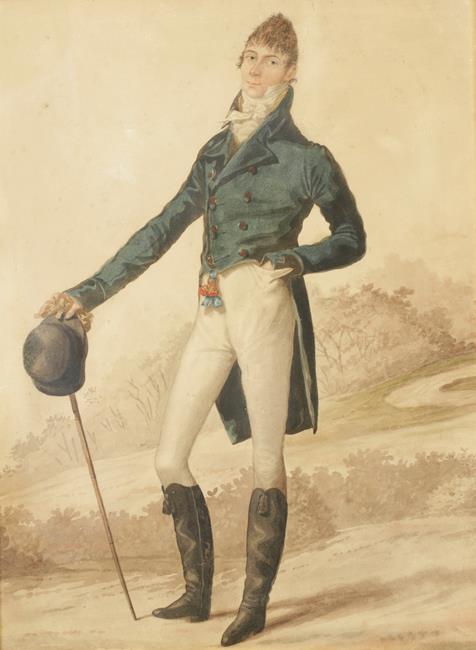
This is a dandy. You can see that because of the cut of his jacket and lack of overall decoration on the fabric he is wearing.
https://genusrosa.me/tag/dandy/

Journal #14

Q: Who is Beau Brummel and why is he important to fashion in the 19th century? Do we have a modern Beau Brummel? Who and why and post a picture.

Beau Brummel, originally named George Bryan Brummell, was the 19th century version of a fashion icon. He was likely called Beau, because a beau was a well dressed man often associated with high society and wit. The clothes he was the trend setter for was relatively undecorated (except for the waistcoat which could have designs and embroidery on it), yet perfectly cut (well-tailored), clean (bright, non-faded colors that are perfectly starched) clothing and neckclothes. He is often associated with men’s modern suits today. It was said he took five hours to dress, and he polished his boots with champagne. He was the first dandy. He was often given clothes for free to wear around to drum up business for the stores who gave them to him. He often wore them as a sort of an advertisment.

I think there are many versions of Beau Brummel today. If you go on Instagram, so many people are being given product and money just to post about certain products regardless if they are fans. This is similar to how Beau Brummel would just wear around clothes as an advertisement. I do not know if I can think of one specific person because a lot of celebrities are trendsetters, but the most Beau Brummel-esque man I can think of would be Kanye West with his line, Yeezy, which released the first shoe of the line on Oct 29, 2015. When he first came out with the line many thought it was crazy and wild because it was unlike styles that were being worn at the time. However, in the last few years it has gone from shoes to a whole clothing line that he has started to wear around making it acceptable and cool. If we are including Kanye in this, we also need to talk about Kim Kardashian because he also dresses her in his Yeezy clothes (along with all her sisters). Kim was wearing skin tight bike shorts out to parties and just last year, I saw girls on campus also wearing similar bike shorts. They have created a very unique style that is loved by a particular group of people; just like the Dandy culture.

Journal #13

This is an example of deshabillé. Madamae de Pompadour wore these – a deshevelled yet put together look. It is clear that this is 18th century deshabillé because of the decorated bodice and the elbow length, puffy, decorated sleeves.
https://en.m.wikipedia.org/wiki/Portrait_of_Madame_de_Pompadour
This is clearly 18th century because of the tall hair filled with the branches and flowers. This was another Rococo style inspired by Madame de Pompadour, she started a “craze” of towering hairstyles with decorations.
https://www.pinterest.com/pin/483433341220174744
This man is wearing a tricorn hat, a hat with three corners, that would be decorated with a lace trim, braids, or feathers.
https://www.coulborn.com/furniture-categories/notable-sales/philip-mercier-portrait-of-louis-de-jean/

Journal #12

It is clear this is a Puritan woman due to her covered head, the drab, simple clothing especially because of the long white collar on her shoulders.
https://www.marshall.edu/mulitlife/anne-bradstreet/
This is a satin gown from the 17 century. It fits with the style because it is made out of satin, it has the scoop neck that held the the breasts down, yes still has the puff sleeve which are cut and slashed.
https://freshfrippery.com/2017/06/26/portraits-of-17th-century-fashion/
For this photo, I would like to draw attention to the long necklace this woman is wearing. It is a 17th century pomander that was used to hide body odor and give the illusion of cleanliness. They were often worn around the neck or hung off belts.
https://en.wikipedia.org/wiki/Pomander

Journal #11

Q: How did the clothing of members of the puritan and royalist factions in the English Civil War differ? What seems to have been the basis for these differences?

A: The royalist faction, also known as Cavaliers, were known for being very flamboyant and showy. They loved their clothes to reflect that; they wore bright colors and highly decorated fabrics. However, the Puritans dressed in very simple clothing that did not often have shape and was of a darker or blander color. The clearest reason for these differences would be their way of life. The Puritans wanted a simply life and were very strict in committing to the simple life in both action and appearance. However, as we have been learning about in some of our most recent lectures, the royals and the rich felt the need to shove their wealth in your face. This attitude/set of ideals coincides quite clearly with how they dressed. They were insistent on making their status known and that is quite the opposite of the Puritans which explains why their dress was so different.